

Precision Data collection■
The VAF SPU3 is engineered to deliver clarity in complex marine operations. Designed for integration with flowmeters, torque sensors, GPS, speed log and additional (existing) sensors, the SPU3 consolidates data into a single Ethernet output. This enables real-time insight via the PEM4 touchscreen (on board) and IVY cloud platform (in office). Whether installed near consumers, booster units or in the engine control room, the SPU3 ensures reliable performance in demanding environments. With support for up to 12 flowmeters and multiple signal inputs, it empowers operators to monitor fuel efficiency of consumers, ships’ propulsion efficiency, and environmental data with precision, The result: smarter decisions, lower emissions, and optimized ships’ efficiency.

Modular / Scalable
Easily adapts to simple or complex vessel configurations.

Real-time data integration
Combines signals from flowmeters, torque sensors, GPS, speed log and additional (existing) sensors into one clear output.

Efficiency monitoring
Enables precise tracking of propulsion efficiency, fuel consumption per engine, per nautical mile, and per kWh.

Seamless connectivity
Connects directly to PEM4 touchscreen via Ethernet or IVY cloud platform for instant insight.

Marine proof
Built to perform in harsh engine room conditions. Vibration, heat, and moisture resistant (IP65)

Smart alarm diagnosticst
Detects and logs signal failures instantly, helping crews act fast and avoid downtime.
WE PRESENT:
SPU-3■
Why choose VAF SPU3
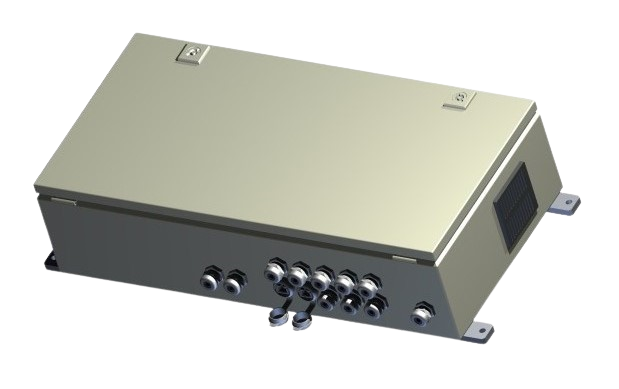
The VAF SPU3 is a high-performance Data collection Unit designed to bring structure and insight to complex marine propulsion data. Built for integration with flowmeters, torque sensors, GPS, speed log, and auxiliary systems, the SPU3 consolidates all inputs into a single Ethernet output, ready for visualization on the PEM4 touchscreen or remote access via the IVY cloud platform.
Its modular architecture supports up to 12 flowmeters and 9 analog inputs, making it suitable for both single and twin-screw vessels. The SPU3 enables precise monitoring of fuel consumption, shaft power, thrust, and efficiency metrics such as SFOC (g/kWh) and EEOI(kg CO2/ton NM). It also supports temperature compensation, density calculations, and draft/inclino measurements.
Installation is straightforward, with DIN-rail mounting and clear IO labeling. Built to IP65 standards, the SPU3 performs reliably in demanding engine room environments. Whether you’re optimizing fuel usage or preparing for emissions reporting, the SPU3 delivers the data you need, when and where you need it.
Smart signal processing
- Modular design with up to 12 flowmeter inputs (8 consumers)
- Supports torque, thrust sensors, GPS, speed log, draft, inclinometer and density sensors
- Real-time Ethernet output for PEM4 touchscreen or IVY cloud platform
- Compatible with RS485 Modbus and NMEA 0183 protocols
- Built for engine rooms: IP65 housing, vibration-resistant, DIN-rail mounted
Efficiency monitoring made easy
- Supports up to 12 flowmeter inputs (8 consumers) and multiple fuel types
- Calculates fuel consumption per engine, per hour, per nautical mile, and per kWh
- Temperature and density compensation for accurate mass flow
- Supports Torque /Thrust meter input(s)
- Calculates torque, RPM and Power for ME propulsion
- Calculates Thrust for hull and propeller efficiency
- Visualized KPIs: fuel efficiency, SFOC (g/kWh), EEOI (kg CO2/ton NM), thrust quotient, propulsion efficiency
- Integrated alarm system for fast diagnostics and troubleshooting
Ready for integration
- Seamless connection to onboard systems and external software
- One RJ45 Ethernet output for data transfer and remote access
- Optional calibration and configuration by VAF Instruments
- Designed for both new builds and retrofit projects
- Supports twin-screw propulsion setups and auxiliary power monitoring
Frequently Asked Questions■
Ship data and maritime data analytics form the backbone of modern vessel performance monitoring. By continuously collecting real-time operational and technical data—such as fuel consumption, power, speed, and efficiency indicators—ship operators gain objective insight into vessel behaviour, energy efficiency, and emissions. When structured in a vessel database and analysed using maritime data analytics, this data supports propulsion optimisation, regulatory compliance, and data-driven decision-making at both vessel and fleet level. The SPU-3 enables this process by reliably acquiring, validating, and processing high-quality ship data directly from onboard sensors.
What is ship data in performance monitoring?
Ship data refers to operational and technical datasets such as fuel consumption per engine, shaft power, torque, RPM, speed over ground and derived KPIs like SFOC, EEOI and slip. This vessel data forms the foundation for performance analysis, compliance reporting and propulsion optimisation.
What is meant by real-time vessel data?
Real-time vessel data is operational data that is processed and available immediately during operation, enabling direct performance assessment and operational decision-making. Typical real-time vessel data includes fuel flow, shaft power, vessel speed and load conditions.
How is vessel data stored in a vessel database?
A vessel database combines static ship characteristics (IMO number, vessel type, design parameters) with time-stamped operational data such as fuel consumption, speed, power and environmental conditions. This structure allows correlation between ship behaviour, fuel efficiency and performance trends.
What is maritime data analytics?
Maritime data analytics is the analysis of maritime shipping data to identify performance degradation, inefficiencies and optimisation potential. It includes filtering, validating and correlating sensor data to support fuel optimisation, hull and propeller performance analysis, and regulatory compliance.
How is data analytics in the shipping industry applied in practice?
Data analytics in the shipping industry is used to support decisions on speed management, engine loading, maintenance planning and compliance strategies. By comparing measured vessel data with reference models, deviations from design performance can be objectively identified.
What role does the SPU-3 play in ship data acquisition?
The SPU-3 acts as a central data processing unit for multiple sensors, including fuel flow meters, shaft power sensors and GPS. It aggregates and validates ship data into real-time vessel data that can be displayed locally or transmitted for further maritime data analytics.
What types of maritime shipping data can be processed by the SPU-3?
The SPU-3 supports acquisition of:
- fuel flow per engine
- shaft torque and power
- vessel speed
- thrust and propeller efficiency
- derived indicators such as SFOC, EEOI and CO₂ per ton-mile
This creates a comprehensive dataset for propulsion and performance monitoring.
How does vessel data support regulatory compliance?
Continuous collection of vessel data enables objective monitoring of energy efficiency and emissions. Maritime data analytics allows operators to quantify the effect of operational measures and demonstrate compliance with regulations such as IMO CII and EEXI using verified maritime shipping data.
What is the advantage of real-time vessel data compared to manual reporting?
Real-time vessel data removes subjectivity and logging errors associated with manual reports. It provides consistent and reproducible ship data suitable for trend analysis, benchmarking and automated reporting to management and authorities.
How does maritime data analytics support fleet-level decision making?
By combining vessel data from multiple ships into a central vessel database, fleet-wide performance trends can be identified. This enables benchmarking between vessels, early detection of degradation patterns and better-informed decisions on maintenance strategies and retrofit investments.
Our experts are
standing by■
Ensure accurate reporting and meet compliance standards with our advanced data solutions. We have what you need.
Erik van Ballegooijen | R&D Director